Seventh and final in the series: The Post-Photographic Shift Continuum of Creation
AI-assisted photography is not the end of the medium. It is the newest form of its oldest question: how are we going to define what fine art photography is?
Every series must end somewhere. This one ends with a position, not a resolution. The argument is not finished. A place to stand while the conversation continues.
That place is a position, and it is this: the standards applied to AI-assisted photography are not aesthetic standards. They are historical residue: the accumulated weight of decisions made for specific reasons in specific moments, defended past the point where those reasons hold, and maintained now largely by the inertia of institutions that find change more threatening than inconsistency.
That is a strong claim, and this series has spent seven articles building the case. What remains is to say what that case asks of the art world, not as a list of demands, but as an honest account of what it would look like if institutions applied their own stated principles consistently.
What the series has established
The argument did not begin with AI. It began with photography’s own history, with the documentary ethic that migrated from photojournalism into fine art criticism and arrived without its context, becoming a standard that the medium it was meant to serve had never fully agreed to.
It moved through the art world’s actual record of how authorship works, examining Hirst’s delegated spot paintings, Warhol’s factory, and LeWitt’s instructions, and found that the standard being applied to photography had never been applied consistently to any other serious medium. The inconsistency is not incidental. It is the argument.
The pattern repeated across the history of aesthetic liberation. The Impressionists were outside the Salon. Photographers were outside the galleries. Digital artists were outside the auction houses. In each case the resistance was framed as aesthetic but driven by the threat to existing hierarchies of skill and the disruption of markets built on scarcity.
It established that authorship in AI-assisted work is traceable, visible, and present at every stage of a serious body of work: in the decisions made before the image exists, in the selection and shaping of what the process produces, in the coherence of the resulting body of work. And it proposed standards for evaluating that work that are universal, defensible, and consistent with how serious art has always been assessed.
Seven articles. One argument. What does it ask of anyone in a position to act?
What institutions owe the work
The institutions that shape photography’s critical landscape, the galleries, the open calls, the collections, the publications, the prize committees, are not passive observers of the argument this series has been making. They are participants in it, whether they choose to be or not. Every blanket ban on AI-assisted work, every curatorial decision that defaults to process over outcome, every acquisitions policy that excludes a category of work without examining it, is a position taken. Positions have consequences, and the consequences here are not abstract.
Artists are developing serious work with AI tools right now. Bodies of work are accumulating that engage deeply with photographic history, that demonstrate genuine artistic intelligence, that meet every standard serious criticism has ever applied to fine art photography, except the one that asks how the image was made. Those bodies of work are being systematically excluded from the institutional structures that would allow them to be seen, evaluated, and placed in relation to the broader conversation about the medium.
That exclusion will look, in retrospect, like the exclusion of photography from the galleries in the 19th century. The parallel is not exact. But the shape of the error is the same. The institution that decided the camera could not produce art did not think of itself as making an error. It thought of itself as protecting a standard. It was protecting an arrangement.
What institutions owe the work is straightforward: actual engagement. Not automatic acceptance. The standards this series has proposed are genuine ones and they require real judgment. But engagement. The willingness to look at what the work is doing before deciding whether it belongs.
What critics owe the conversation
The critical vocabulary for AI-assisted photography is underdeveloped, and that underdevelopment has consequences. When the language for discussing a body of work does not yet exist, the work tends to be assessed by the nearest available vocabulary, which in this case is a combination of technology journalism and medium-purity debates that neither describes what the work is doing nor provides a useful basis for evaluation.
The critics who developed the vocabulary for straight photography, for conceptual art, for digital practice, were not describing work that already had a language. They were building the language as the work demanded it. That is what criticism at its most useful does: it creates the conditions under which new work can be seen clearly.
AI-assisted photography needs that now. Not advocacy and not dismissal, but the careful, sustained attention that produces description precise enough to be useful. What are the distinguishing qualities of the strongest AI-assisted photographic work? What separates a body of work with genuine artistic intelligence from one without it? What is the relationship between this work and the generative and concrete photography that preceded it? These are answerable questions. They require someone to do the work of answering them.
What the market owes the artists
The collector and dealer market for AI-assisted photography is nascent and unevenly distributed. Collectors already comfortable with generative and code-based work have engaged with it for years. The traditional photography market has largely held back, partly from aesthetic conservatism and partly from genuine uncertainty about how AI-assisted work fits into the market’s existing structures of rarity, authenticity, and provenance on which it depends.
Those structures will need to evolve. They have evolved before: the introduction of the limited edition print, the artist’s proof, the certificate of authenticity were all responses to earlier disruptions in what it meant for a photographic work to be unique and ownable. AI-assisted work presents new versions of the same questions, and the market will eventually develop conventions for addressing them, as it always has.
What the artists working in this space need in the meantime is the same thing artists in any underdeveloped market need: collectors willing to look at the work on its merits before the institutions arrive to ratify that it is safe to do so. That has always been where the most significant collecting happens, in the space before consensus, when the judgment required is genuine rather than ratified.
What the argument was always about
Photography has never been a settled medium. From the moment it appeared, it has been a site of argument about what images are, what they are for, and who has the authority to say. The argument has taken different forms in different eras, about truth and manipulation, about art and document, about the hand and the machine, but it has been continuous. There has never been a period when photography’s nature was agreed upon and the conversation was closed.
AI has not disrupted a stable medium. It has made the instability of the medium impossible to ignore. The questions being asked now about AI-assisted photography, about authorship, about authenticity, about what it means to make an image, are not new questions generated by a new technology. They are photography’s oldest questions, returned in a form that demands an answer rather than being set aside again.
That is not a problem with AI. It is one of the more useful things AI has done for the medium: forced a reckoning the medium has been avoiding, made explicit a set of assumptions that had been operating implicitly for decades, and put the question plainly: what does photography actually stand for?
The camera did not end painting. AI will not end photography. What it will end, eventually, is the fiction that photography ever had a settled identity: that there was a correct way to make an image, a correct relationship between the lens and the world, a correct set of tools that alone could produce work worth taking seriously.
A final word to artists
To photographers working with AI tools, building bodies of work that the current institutional landscape has not yet made room for: the history this series has traced is not offered as consolation. It is offered as context.
The pattern is consistent. The exclusion is real while it lasts, and it lasts long enough to have genuine consequences for careers. The artists who came through equivalent moments in the history of the medium did so not because the institutions changed their minds but because the work accumulated until the cost of ignoring it exceeded the cost of engagement.
Keep working. The argument is already being won in the only place it can be won, in the quality and seriousness of the work itself. The rest follows, and it always has.
Continuum of Creation is the seventh and final piece in The Post-Photographic Shift series, a reasoned case for vision over method in photographic art. The series begins with Photography’s Dilemma.
Acknowledgements
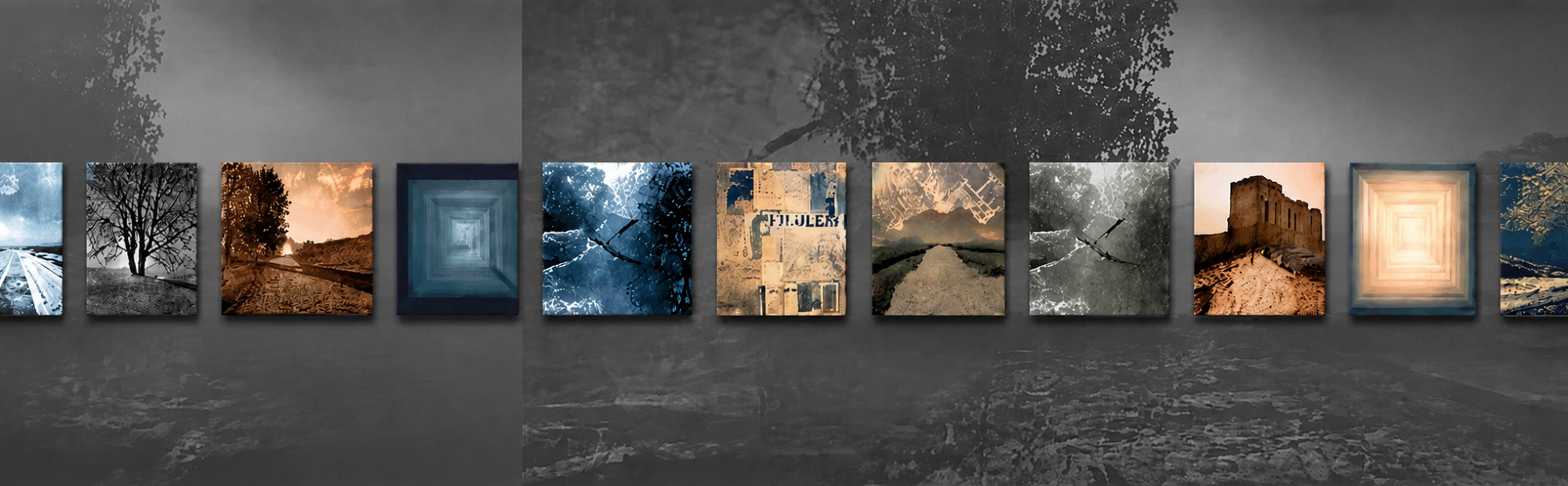
1 Top Banner: Cropped Cape Town (ZA), Sea Point, Nachtansicht by Dietmar Rabich, 2024.
Photographic art based on a view towards Signal Hill at night, Cape Town, Western Cape, South Africa. CC BY-SA 4.0, via Wikimedia Commons