The Shifting Responsibility of the Image On Choosing What Different Publications May Show
Documentary photographs do not remain fixed when they move between editorial settings. Looking back at photographs made at a São Paulo demonstration and published for different purposes, Neil Wildin examines what an image can establish, what surrounding words and editorial choices add, and where responsibility lies between photographer, editor and reader. He does not regret making or licensing the work, but argues that each new use requires its own consideration of context, inference and the people depicted. The essay tests that responsibility through several photographs, including an identifiable child holding a political flag, and considers how editorial scrutiny changed Wildin’s subsequent practice. It concludes that photographers cannot control every later interpretation or circulation of an image, but remain responsible for the photographs they choose to offer and the claims those photographs can reasonably support.
On 11 October 2026, I spent part of the afternoon photographing a demonstration on Avenida Paulista in São Paulo. I was looking for pictures rather than an explanation of Brazilian politics. There were flags, signs, people making their way through the crowd, and others trying to record what they could see. I came home with approximately one hundred photographs and selected fourteen. The series became The Act of Looking.
Within days, the photographs had appeared in two quite different settings. Urban Frontier Insights published the work as an observational photographic essay. Popular Mais used photographs from the same series in an article about Brazil's political future. I was pleased by both publications. I had approached editors because I wanted the work to be seen, and I had given Popular Mais permission to use the images knowing the nature of its coverage.
At the time, I was new to street photography and had just launched a new website. The opportunity to publish felt like reason enough; my focus was on getting the work out, not weighing each outlet's general character. I do not now regret sending the photographs to Popular Mais. Its treatment was considered and did not push the images toward political drama. This essay is a retrospective examination of my choice, not a claim that the first publication was a mistake.
It would therefore be misleading to describe the second publication as something done to my photographs without my involvement. I had decided to make them available. What interested me afterwards was whether I had thought carefully enough about what that decision meant for the people in the pictures.
The decision I made
At the demonstration I made the usual photographic decisions: where to stand, when to raise the camera, how much of the crowd to include, and what to leave outside the frame. Later I chose the images I thought worked. None of those choices established what a photographed person believed. They determined what I could show of a particular encounter
Licensing the pictures involved another kind of choice. I knew that Popular Mais would be interested in the political event as well as the people attending it. I did not require the publication's political opinions to correspond with mine. Documentary images would have limited value if photographers supplied them only to editors whose conclusions they shared. Yet a reader could make the opposite argument: if every documentary photographer became more cautious, the public record of political protest might thin. That is a serious objection, and I cannot dismiss its possible collective cost
Agreeing to an editorial use is not the same as declaring myself uninvolved in what follows. I did not make these checks at the time. I could have asked how the pictures would be presented, supplied accurate descriptions, or withheld one that I thought was likely to mislead in a particular setting. I did not control the article, but I did control what I offered.
The distinction became clearer when I looked at the two published versions. A photograph of somebody recording the demonstration could support an essay about how people look at public events. Beside an article about an election, the same person becomes part of the visual evidence of a political gathering. Neither placement necessarily misrepresents the afternoon. The difficulty begins if the surrounding words encourage a reader to infer beliefs or intentions that the image cannot establish.
I could not have predicted every interpretation, and it would be unreasonable to expect that of any photographer. Looking back, I would be more deliberate about the publication's general character and the kind of claims it tends to make, avoiding outlets whose coverage is extreme. That does not require agreeing with a publisher's politics or refusing publication. It means matching any claim to what the image can show and asking what a new use adds. I would still photograph the same scenes and seek broad circulation; perhaps I would publish in eight places rather than ten. But if many photographers made that calculation, the record might become thinner. I do not know how to resolve that tension.
In this case, I did not believe the photographs had been misused. That is worth stating plainly. A political publication had used documentary photographs of a political event, and I had agreed to that arrangement. My unease arose from something less dramatic: being satisfied with the result had left me less reason to scrutinise my own decision to supply the pictures. If I had been unhappy with the article, it would have been easy to scrutinise the editor. Because I was pleased to see the work published, I had less incentive to scrutinise myself. That difference in my response is part of the problem.
Who is in the frame?
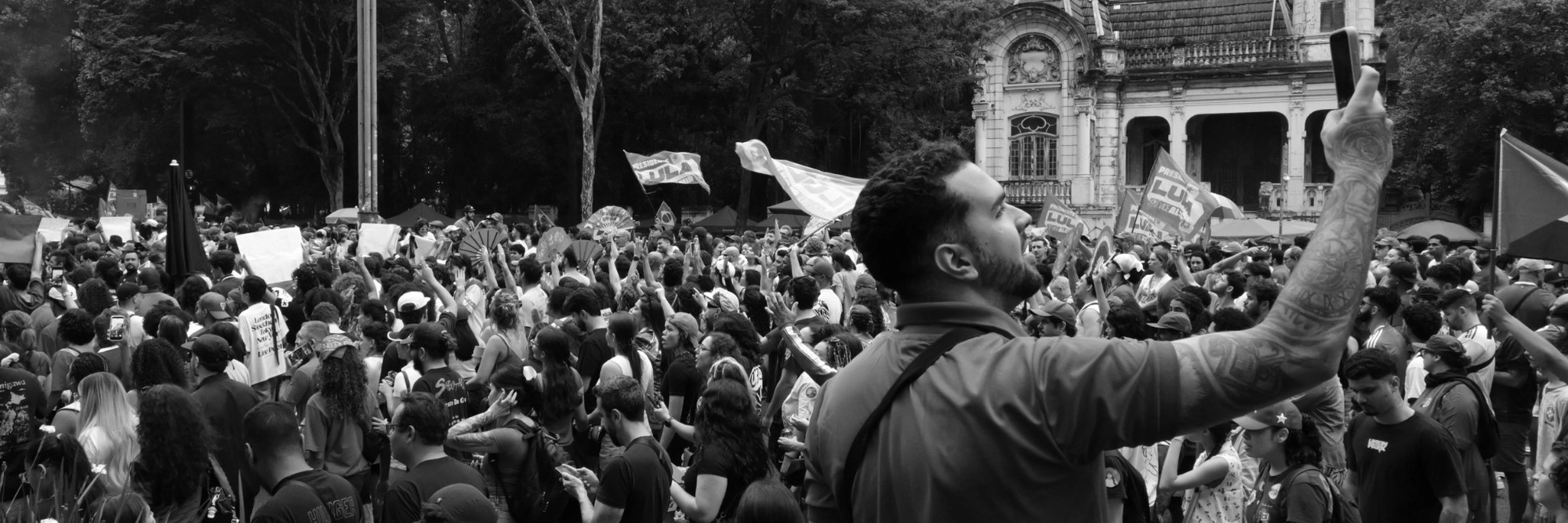
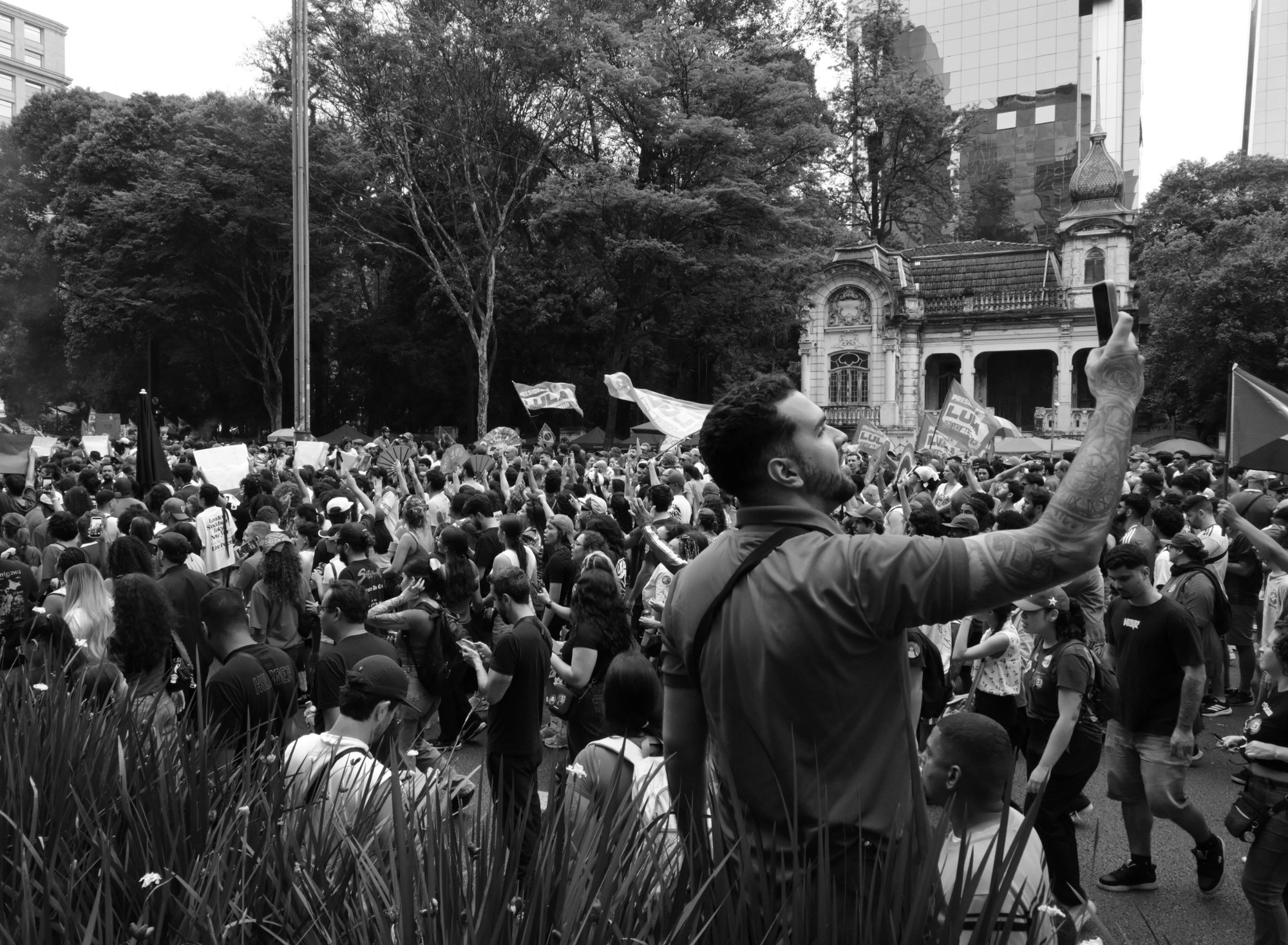
In Witness to the Crowd, a man raises his phone above the people around him. I photographed him as he was apparently making his own record of the gathering. I do not know what he intended to do with it. He might have been preserving a memory, sending something to a friend, or documenting an event he considered important. The photograph establishes the gesture, but I have no way of choosing among those explanations.
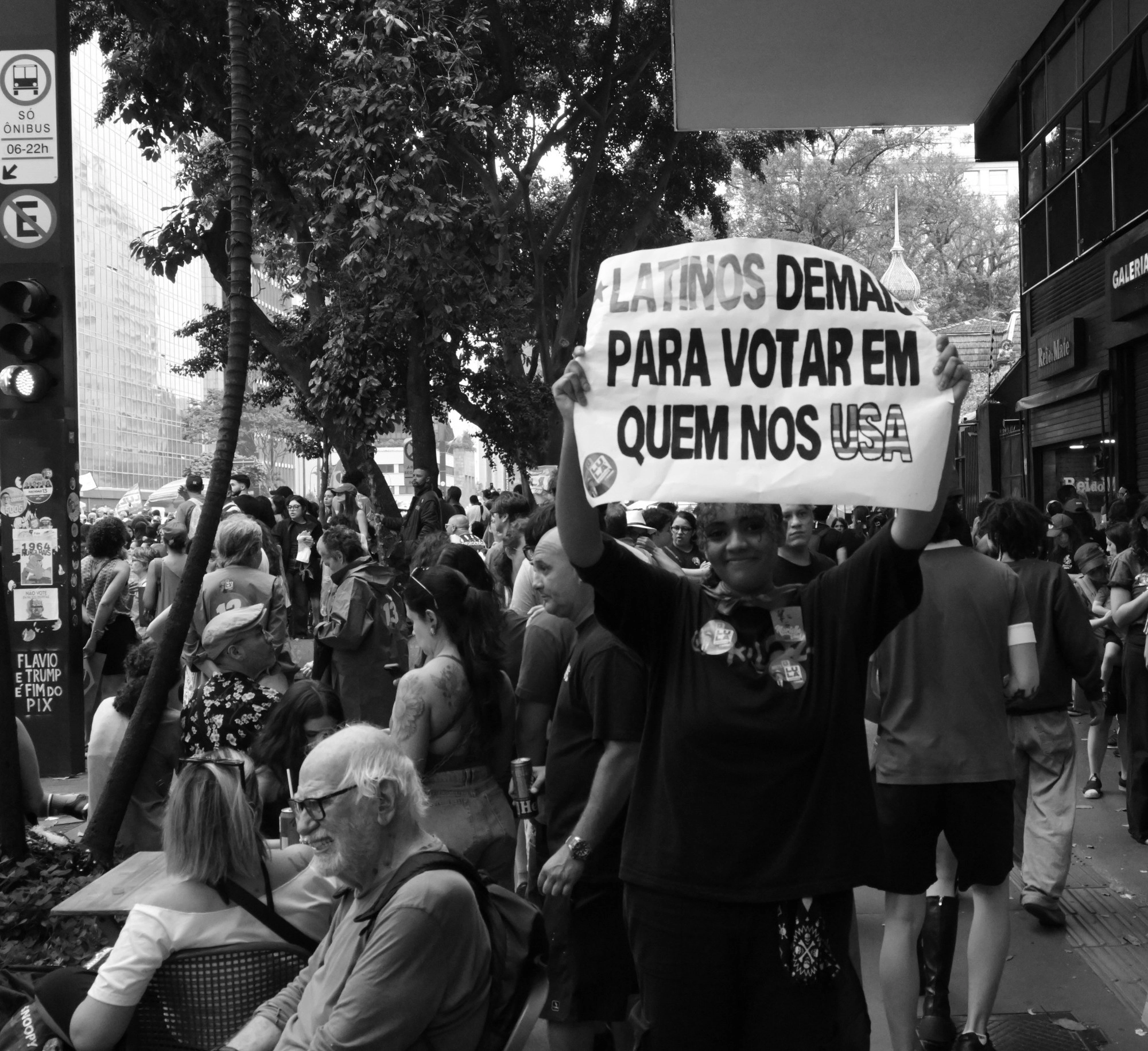
The Message shows someone holding a handwritten political sign. Here there is more evidence of an intention to be seen. The person has raised a message in public, and I can describe the words and the act of displaying them. Even so, I cannot treat that single gesture as a complete account of the person's beliefs or circumstances.
In A Different Perspective, people have climbed into the branches of a tree above the avenue. Their elevated position interested me because it changed the relationship between the crowd and the surrounding city. They were visible from where I stood, but they were not necessarily making a public statement. I turned their activity into a photograph for reasons of my own.
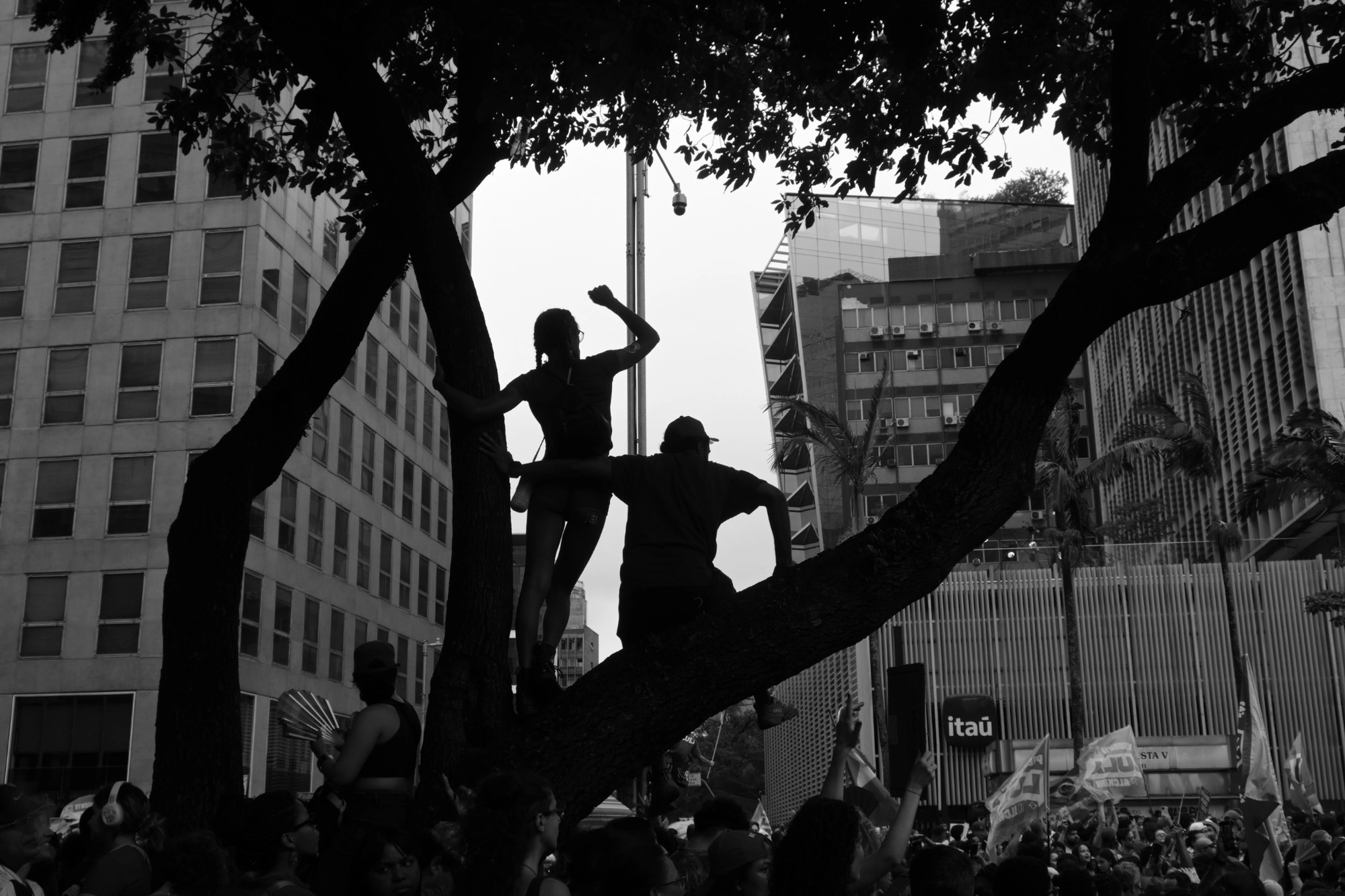
Those differences matter when I choose what to publish. A sign deliberately shown to a crowd, a man recording something on his phone, and people looking down from a tree do not all invite the same assumptions. They may be present at the same demonstration without having the same relationship to it.
There is also a photograph of a child holding a political flag. When I first wrote about this work, I treated such a photograph as a hypothetical example. That let me avoid the more difficult fact: I had made this image, selected it for the series, and proposed it to this publication for reproduction. At the time, I saw it as aesthetically strong and powerful in its context. I do not regret taking or selecting it. I had not yet considered the questions about the child’s rights and protection that emerged during the editorial review of this essay.
The child and flag are visible; the child’s understanding of the event is not. I knew I was photographing a pro-Lula rally and understood the flag as political, but I had not thought through what it meant to circulate an identifiable child in that setting. The editorial review of this essay brought the child-protection questions into focus. I now see that the photograph’s meaning for me does not settle whether another publication should show it.
This publication has decided not to reproduce the photograph here, a decision I return to below.
The decision also made clear that a careful caption cannot resolve every concern. The child’s face and the political flag remain visible whatever I write beneath the image. A caption may limit an inference, but it can also add information that makes someone more identifiable or more closely associated with a political position. Accurate details are not always details that need to be published. The editor and I should be able to explain why each detail is necessary.
This has changed what I will offer in the future. I will not offer this photograph for further publication. At a rally a week later, I consciously chose not to photograph children holding political banners or flags. That did not feel like leaving something out of the documentary record; I believe I photographed the event without misrepresenting it.
What another use requires
Ariella Azoulay's The Civil Contract of Photography challenges the idea that a photograph belongs, in every meaningful sense, to the person who made it. Her account of the photographic encounter brings the photographed person and the spectator into a continuing relationship with the photographer. It is useful here because it prevents me from treating the people in my images as material whose significance ends when I press the shutter.
Within Azoulay's broader account of photography as an ongoing relation, I focus on a practical question: how each new publication redistributes responsibility according to what the photographer and editor know and can control. The photographer, editor and reader do not act at the same time, with the same knowledge, or with the same means of changing the result.
I chose to take the photograph and later to license it. The editor selected a context, headline and accompanying argument. A reader encounters the combination and may draw conclusions neither of us intended. These roles cannot be collapsed into one general responsibility. Nor can they be separated so completely that each person dismisses the consequences of the other's choices.
I remain responsible for the photographs I choose to offer and for what I know about their circumstances. At the time, I had not considered the child’s protection in the way I do now. What I know now changes what I am willing to offer for another publication. Editors remain responsible for the claims and associations their words add. If a specific misrepresentation appears, I can seek a correction; here, my concern is whether each new use is justified.
The editor also raised legal and ethical questions about publishing an identifiable child beside a political symbol. I am not making a legal conclusion about whether either earlier publication was permissible. A photograph made in a public place still needs to be considered in relation to the person shown and the proposed use. An editor may decide not to publish an image even when its publication could be legally permissible.
I proposed this photograph to this publication as a third editorial use: evidence in a critical essay about photography. My first instinct was that readers needed to see it. The publication has decided not to reproduce it, and I respect that judgment. The image still has value, but showing it is not necessary for the essay to examine the choices around it. Discussing the photograph and the decision not to publish it is enough; the child does not need to appear before another audience for the argument to be made.
When I first went through the fourteen photographs, I was deciding which were the strongest pictures. I still think that was a legitimate beginning. It was not, however, the last decision I would be asked to make about them.
I want the work to circulate, but different editors may reach different judgments about a photograph. . I will leave the image in its existing publications, but I will not offer it for future publication. That choice does not make every later use predictable or controllable. It means that, now that I have considered the child’s protection, I can make a different decision about what I offer next.
About the Author
Neil Wildin is a photojournalist and writer based in São Paulo. His professional background was in business consulting, and photography had accompanied him for years. In England, he also worked commercially, photographing the architecture and interiors of historic cathedrals and abbeys. Since moving to Brazil, he has focused his documentary work on contemporary social life and the people who use the city’s shared spaces. His photographs and essays consider how people experience public life and how images shape what others see.
References and Prior Publications
Ariella Azoulay The Civil Contract of Photography| New York: Zone Books, 2008
Neil Wildin “The Act of Looking” | Urban Frontier Insights, 14 October 2026
Popular Mais “Não é mais apenas Lula contra Flávio Bolsonaro: o Brasil decidindo que sociedade quer” | October 14, 2026