The Building Was the Draft Le Corbusier corrected the photographs, not the buildings
Le Corbusier retouched the photographs of his own buildings before he let them be seen, removing whatever broke the line. The corrected photograph, not the building, became the record, and it still decides how the buildings are shown.
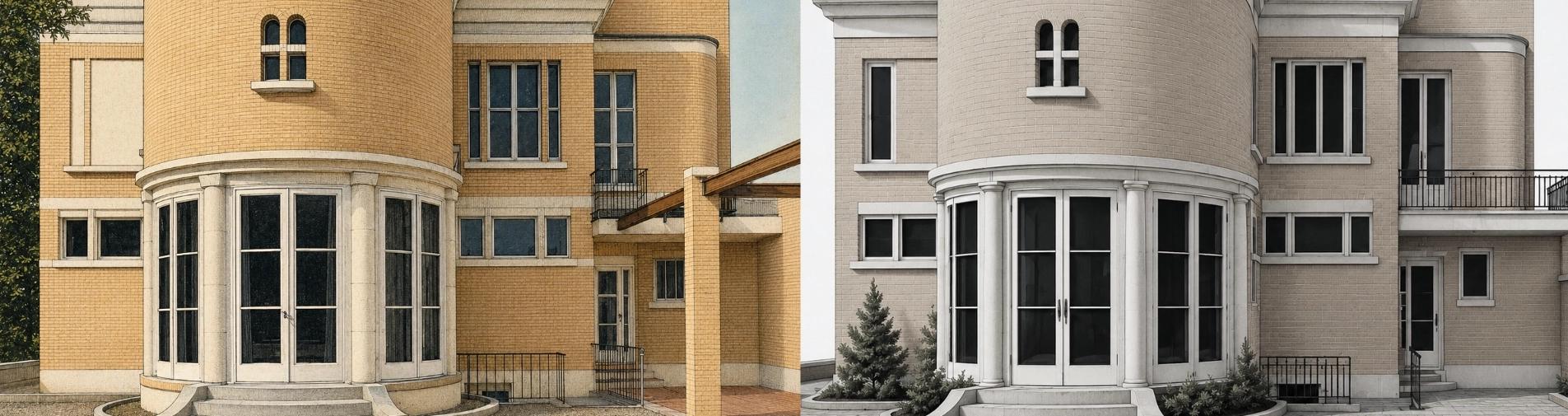
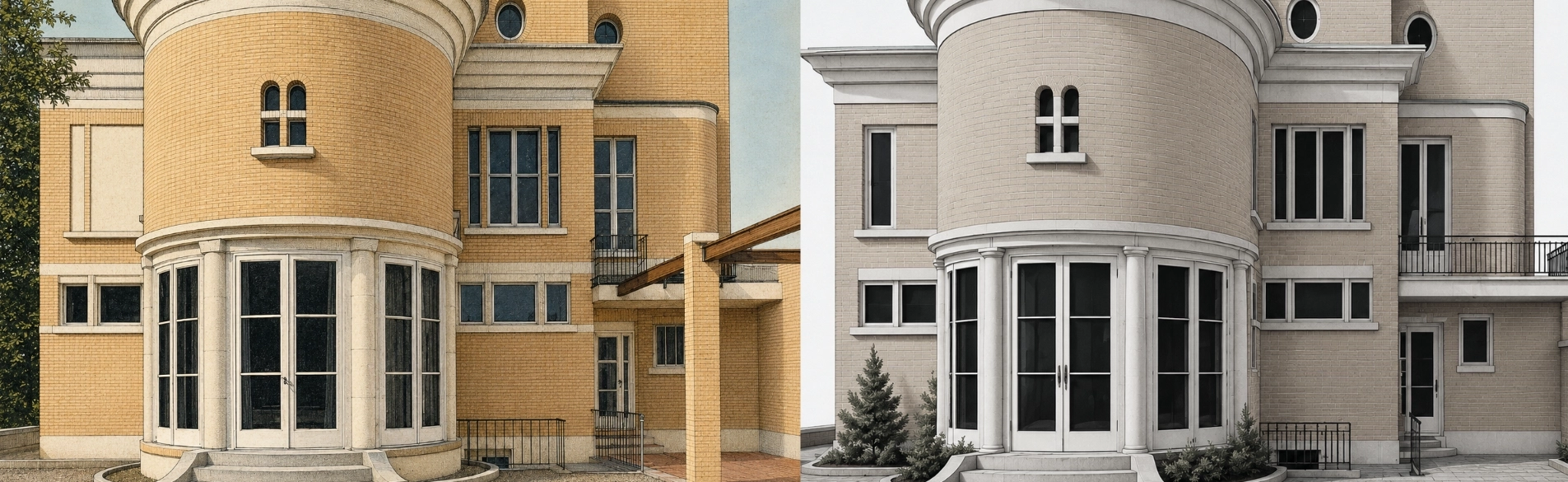
The house had a pergola, but in the photograph, there is none.
Le Corbusier finished the Villa Schwob in La Chaux-de-Fonds in 1916. When it appeared in L'Esprit Nouveau five years later, the photographs had already been corrected. The pergola in the courtyard was gone, leaving a pale trace on the ground. The climbing plants went. The bushes went. The dog house went. He straightened the service entrance and squared off a window into a clean rectangle. What ran in the magazine was not a photograph of the house. It was a photograph of the idea the house was meant to carry, everything else edited out of the frame.
We tend to file this under vanity, or under the small dishonesties every architect commits when the camera comes out. It is neither. He did it to building after building, and to buildings that were not his: to a photograph of Pisa, to a Roman church, to the Parthenon. It was too consistent to be vanity and too deliberate to be a touch-up. For Le Corbusier the photograph was the work and the building was the draft. The correction was not applied to the architecture. It was the architecture, finished in the photograph rather than on the site.
That reversal is the whole matter, and it is worth stating plainly before the evidence for it. We treat the building as the work and the photograph as its record. Le Corbusier ran the order backward. The building was a stage the idea passed through on its way to its final form, which was the photograph on the page. What follows is how he did it, and what it still costs us.
A method, not a touch-up
It was how he worked, building after building. In the photographs of the Villa Savoye, he painted out columns the building actually had, greying away the ones that disturbed the composition. The section he published in the Oeuvre complète answers to an earlier version of the design, not to the house that was built. He was not documenting the Savoye. He was correcting it.
The same hand reached back across centuries. He traced over a photograph of Pisa to sharpen its lines into pure geometry. He marked up photographs of the church of Santa Maria in Cosmedin in Rome with instructions to strip out the tabernacles, the decoration on the arches, the pillows, anything standing between the reader and the shape he wanted seen. The caption told the reader what to conclude: Greece by way of Byzantium, "noble prisms, seen in light." The building in Rome was raw material. The photograph, once corrected, was the finished work.
None of this was hidden, and none of it was careless. It was a considered method for turning a specific building on a specific site into something else: a demonstration, cleared of everything that would tie the building to one place, one client, one afternoon's weather.
The version that ran
Purism began as a painting movement, one Le Corbusier set out with Amédée Ozenfant in Après le cubisme in 1918 and argued through the pages of L'Esprit Nouveau: clarity, geometry, the refusal of ornament. A painting can hang on a wall and be seen. A building cannot. It sits on a site, it weathers, it fills with furniture and people and compromise, and it cannot be walked through by a reader in Berlin or Buenos Aires. The building had to be carried to those readers, and what carried it was the photograph.
So, the photograph did not illustrate Purism. It was how Purism reached anyone at all. And because a photograph could be corrected in ways a building could not, the version that reached people was always purer than the one that got built. When a building goes up, Le Corbusier held, it mixes with the world and loses its clarity; on the printed page it becomes pure idea again.
Look at who is missing from the photographs. The interiors are empty, or nearly so, arranged and lit and vacated before the shutter opened. When a figure appears, it is small and stylized, placed to give scale rather than to suggest a life. The family who commissioned the Villa Schwob never appears. The house is shown as a diagram of a theory, not as a place where someone ate breakfast. A photograph with a person in it is a photograph of a life. A photograph without one is a photograph of an idea, and the idea, not the life, was the point.
Le Corbusier's reversal outlived him. The buildings still stand, and you can visit them. The strange part is how they are still photographed for the magazines and the monographs: the object alone, the site cropped back, the surroundings and the people and the wear cleared from the frame. That is the view Le Corbusier fought for, and it is still the one the profession reaches for first. He did not only retouch his own photographs. He helped set the terms by which a building is shown as a pure object, cleaned of anything that would tie it to a place or a life. The correction became a convention, and most of us stopped seeing it.
What we call it now
Which brings us to the argument we are actually having. There is a widespread conviction at the moment that the manipulated image marks a fall, that photography was once a form of honest testimony and has lately been corrupted by tools that let the maker fabricate rather than record. The anxiety is loudest around images made or altered by machine, and it carries a note of grief for a truthfulness presumed lost. Set that conviction next to the Villa Schwob. The most influential images in the history of modern architecture were fabrications. The discipline did not merely tolerate them. It canonized them, taught from them, built a century of understanding on the corrected version, and let that version set how the real buildings would be photographed long after the retouching was done. There was no age of the untouched photograph to fall from. In the hands of the century's most consequential architect, the manipulated image was not a corruption of the record. It was the record, and its authority came not from its fidelity, but from who controlled its reproduction.
The question was never whether the image had been worked on. Every image that ever mattered had been worked on. The question was the older one, the one Le Corbusier answered by taking the money and the means: who decides what the public sees, and to what end.
The pergola
The pergola still stands in La Chaux-de-Fonds. You can walk up and put your hand on it. The photograph he cleared of the pergola is the one the century kept, reprinted and taught and handed down as the record of the building. Le Corbusier understood something the field has been slow to admit about itself. The building is where architecture happens. The image is where it is decided.
Resources
Le Corbusier and Photography | Beatriz Colomina | Assemblage, No. 4, October 1987, pp. 6–23
Who Shot Le Corbusier? The Architect of the Century and His Photographers | Daniel Naegele | TU Delft Open, 2020
Vers une architecture | Le Corbusier | Éditions Crès, 1923
L'Art décoratif d'aujourd'hui | Le Corbusier | Éditions Crès, 1925
Le Corbusier: Elements of a Synthesis | Stanislaus von Moos | MIT Press, 1979